 ChatGPT
 Claude
 Gemini
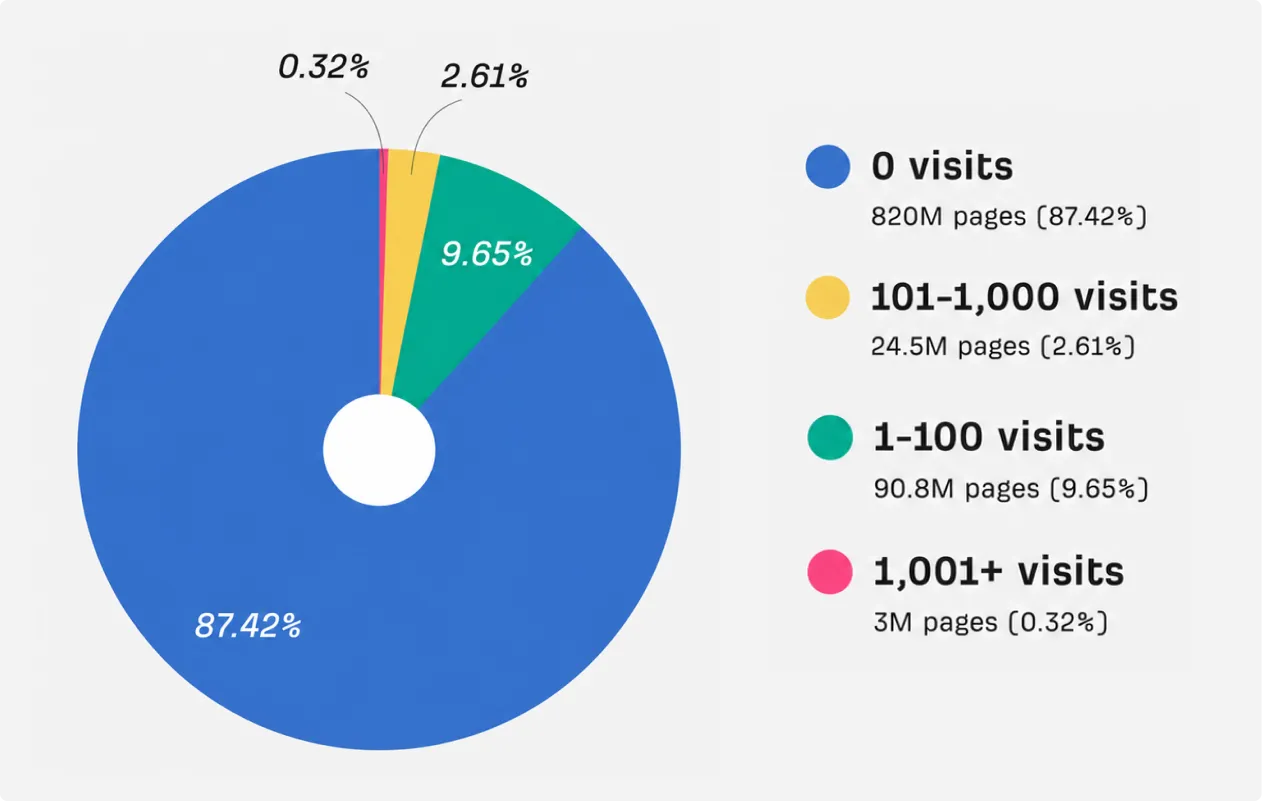
90% of pages on the internet get zero organic traffic from Google. Not because they were written poorly. Not because they were ignored by Google. But because they were written about topics nobody was searching for in the first place.
That is the keyword research problem. And it is entirely avoidable.
Keyword research is the process of finding the exact words and phrases your target customers type into Google when they are looking for what you offer. Get it right, and you are publishing content that people are actively searching for. Get it wrong, and you are writing into a void.
If you are new to how search engines work in general, our SEO Made Simple Guide covers the foundation. This guide picks up from there and walks through keyword research step by step, from finding ideas to understanding what the metrics actually mean to deciding which keywords a new or small website should realistically target first.
What Makes a Good Keyword?
Before opening any tool, it helps to understand what you are actually looking for. A good keyword is not just a word with a lot of searches behind it. It is a word or phrase that has three things at once:
Search demand. People are actively searching for it on Google. A keyword nobody types does not send you traffic regardless of how well you rank.
Relevance to your business. The people searching for it are likely to become customers, or at least move one step closer to becoming one. An interior design firm ranking for "how to fold napkins" is attracting the wrong audience entirely.
A realistic chance of ranking. The existing competition for that keyword is not so strong that a new or small website has no path to the first page.
All three of those things have to be present. High search volume alone is not enough. Relevance alone is not enough. Most beginners optimise for one of these and ignore the other two.
Step 1: Start With Seed Keywords
A seed keyword is a short, broad term that describes your niche or service. It is not what you will necessarily target; it is the starting point for finding what you will target.
If you run an interior design business, your seed keywords might be:
interior design
home renovation
living room ideas
interior designer near me
small apartment design
Do not overthink this stage. Write down five to ten words or phrases that describe what you do and what your customers might type when they need you. Those are your seeds.
You can also use ChatGPT to generate seed keyword ideas. Simply describe your business, target audience, and services, then ask for a list of seed keywords. For example:
"I run an interior design company in London specialising in residential renovations. Give me 20 seed keywords my potential customers might search for."
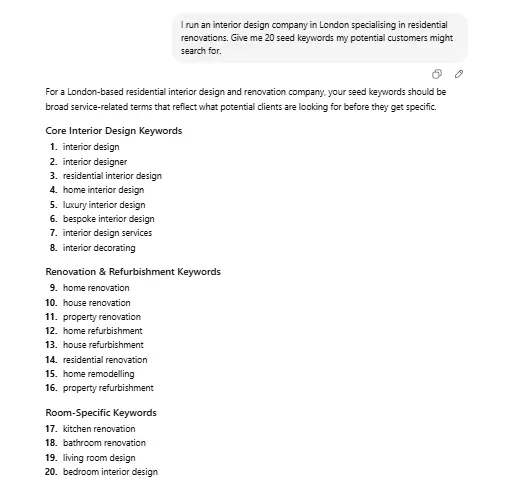
ChatGPT can help you uncover keyword variations, service-related terms, and customer-focused phrases that you may not have considered, giving you a stronger starting point for your keyword research.
Step 2: Expand With a Keyword Research Tool
Once you have seed keywords, a keyword research tool uses them to surface hundreds or thousands of related search queries, along with data on how many times each one is searched monthly and how competitive it is.
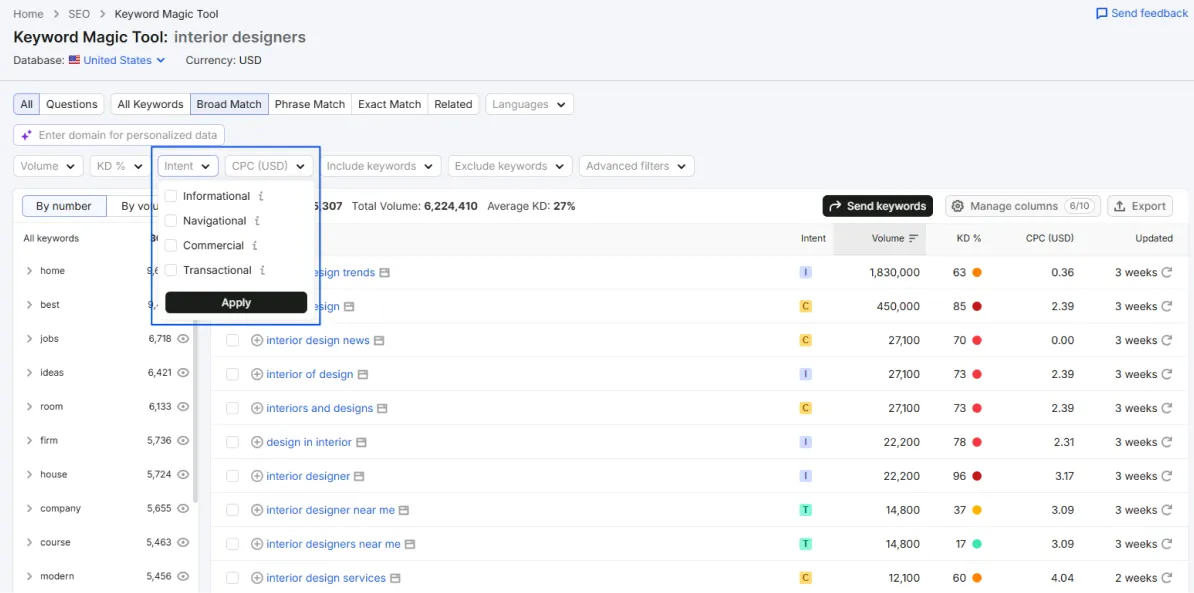
Semrush is the tool most professionals use. Enter a seed keyword into Semrush's Keyword Magic Tool, and it returns related keywords, question-based keywords, long-tail variations, and their corresponding metrics, search volume, keyword difficulty, and CPC.
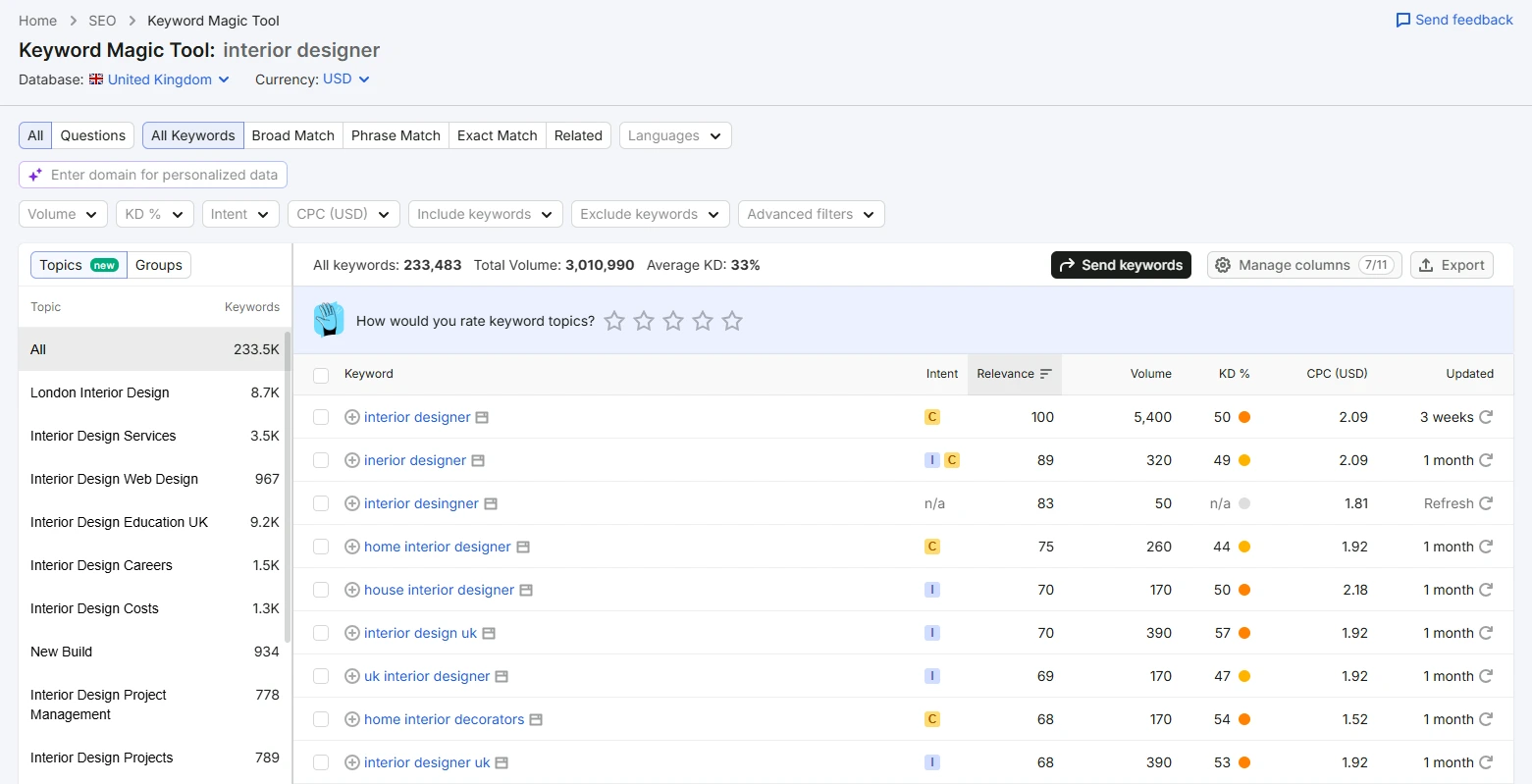
You can filter by difficulty, by search volume range, and by intent. For a serious SEO campaign, it is the most complete tool available.
Google Keyword Planner is the main free alternative. It was built for Google Ads rather than SEO, but the keyword ideas it surfaces are drawn directly from Google's own data. Go to ads.google.com/home/tools/keyword-planner, select "Discover new keywords," and enter your seed terms.
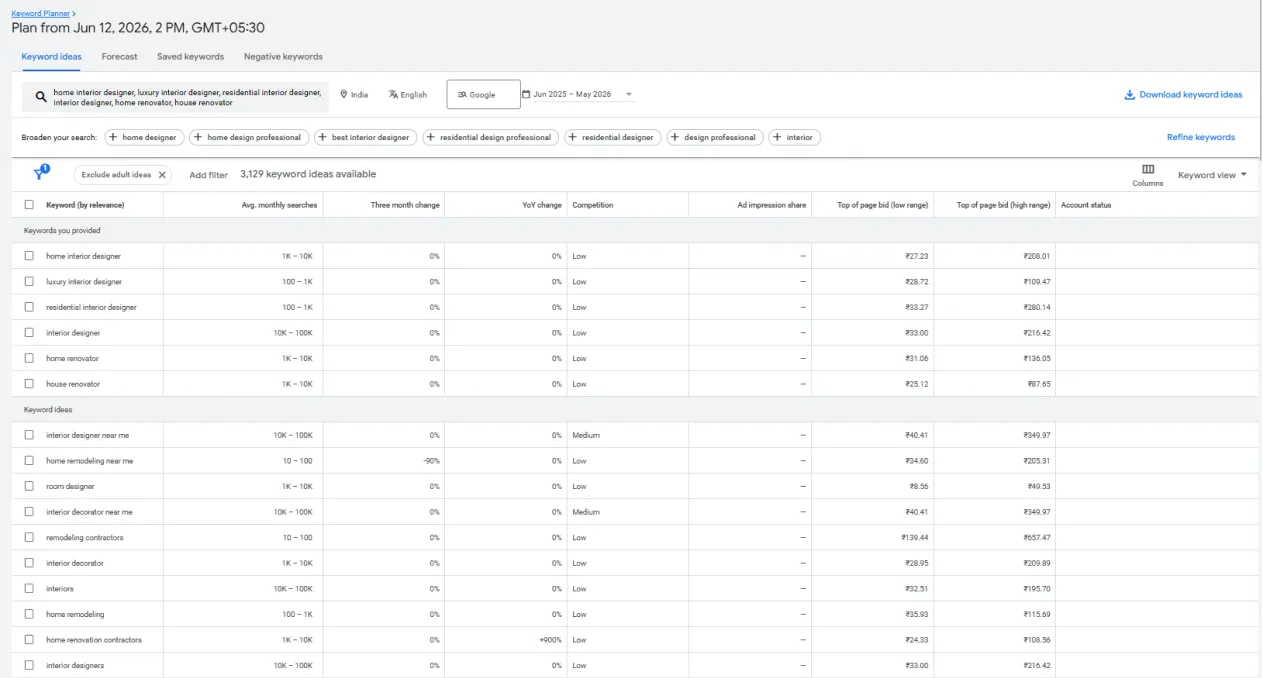
You get keyword suggestions, broad monthly search volume ranges, and competition levels. The search volume data is less precise than Semrush; you get ranges like "1K–10K" rather than exact figures, but for a new website just getting started with keyword research, it is more than sufficient.
Google Search itself is underused as a research tool. Type a seed keyword into Google and look at three things: the autocomplete suggestions that appear as you type, the "People also ask" box in the results, and the "Related searches" at the bottom of the page. Every single suggestion and question Google shows you is real data about what people are searching for. It does not come with volume numbers, but it reliably surfaces intent and phrasing that tools sometimes miss.
Google Search Console works slightly differently. Rather than discovering new keywords, it shows you the keywords your existing pages are already appearing for, even if you are not ranking on page one yet.
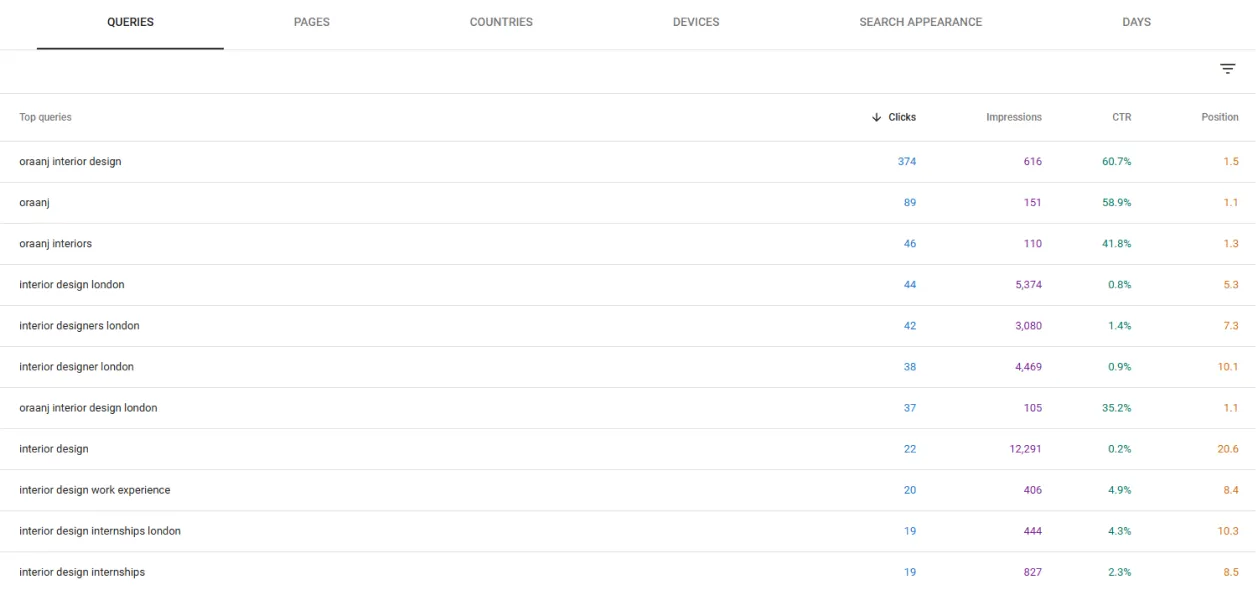
Once your site has been live for a few weeks, Search Console surfaces queries that Google is showing your pages for, including ones you may not have intentionally targeted. These are often the best opportunities on an established site because you are already partway there.
Step 3: Understand the Metrics That Actually Matter
When you open a keyword research tool, you will see several data columns. Here is what each one means and how much weight to give it.
Search Volume is the average number of times a keyword is searched per month. It is the most commonly referenced metric and the most commonly misused. A keyword with 500 monthly searches is not inherently better or worse than one with 50. What matters is whether the traffic from that keyword will actually benefit your business, and how realistic it is for your site to rank for it.
One critical thing to understand: search volume is an annual average. A keyword like "living room Christmas decorating ideas" might show 1,000 monthly searches, but that volume is almost entirely concentrated in October through December. The annual average smooths this out and makes it appear more consistent than it is.
Keyword Difficulty (KD) estimates how hard it will be to rank for a keyword based on the strength of the pages currently ranking for it. In Semrush, it is scored from 0 to 100. A score of 0–30 is generally considered low competition. A score of 70+ means the pages currently ranking have significant authority, and a new website is unlikely to displace them in the near term.
Keyword difficulty is a guide, not a verdict. Always look at the actual search results for a keyword before deciding whether to target it. If the first page is dominated by Forbes, House Beautiful, and Architectural Digest for an interior design keyword, those are not competitors a new website can outrank quickly, regardless of what the KD score says.
Traffic Potential is a more useful metric than search volume for estimating how much traffic a page might realistically receive if it ranked well. A page that ranks for one keyword also tends to rank for dozens of related variations of that keyword. Traffic Potential accounts for this by looking at how much organic traffic the current top-ranking page receives across all the keywords it ranks for, not just the one you searched for. In Semrush, this is shown as "Traffic Potential", or you can look at the top-ranking URL directly to assess it.
Search Intent is not a number; it is a classification. Every keyword falls into one of four intent categories:
Informational: the person wants to learn something. ("how to make a small bedroom look bigger")
Navigational: the person wants to find a specific website. ("Houzz login")
Commercial: the person is researching before buying. ("best interior designers in Austin")
Transactional: the person is ready to act. ("hire interior designer near me")
Intent determines what type of page Google wants to rank for a keyword. If you write an informational blog post targeting a transactional keyword, your page will not rank, not because the content is bad, but because it is the wrong format for what the searcher wants. Always check the actual search results before writing. The pages already ranking tell you exactly what Google considers the right format and depth for that query.
Scale Faster and Smarter with Vaphers
From visibility to conversions, Vaphers builds high-performance digital systems designed to attract, convert, and scale your revenue consistently.
Step 4: The New Website Problem - and How to Solve It
This is where most beginners make the mistake that puts them in the 90% of pages with zero traffic.
A new website has no authority. Google does not yet have a track record for it. No other sites link to it. No users have clicked it in search results and engaged with it. Starting from zero authority means that targeting high-difficulty keywords, regardless of how relevant or well-written the content is, will not produce rankings, at least not initially.
The practical solution is to target long-tail keywords.
Long-tail keywords are longer, more specific search phrases that have lower search volume but also significantly lower competition. They are not second-best keywords. They are the right keywords for a website at an early stage.
To illustrate: an interior design website targeting "interior design" (search volume: hundreds of thousands, KD: 80+) is competing against Houzz, Architectural Digest, Pinterest, and HGTV from day one. That is an unwinnable fight for a new site.
The same website targeting "minimalist living room ideas for small apartments" (search volume: a few hundred per month, KD: 15–25) is competing against smaller blogs and niche sites. That is a fight you can win.
Here is the compounding benefit. Ranking for ten long-tail keywords that each send 80 visitors per month produces the same traffic as one mid-volume keyword. But the ten long-tail rankings are achievable in months. The single mid-volume ranking might take years, if ever.
As your site accumulates content, backlinks, and user engagement over time, its authority grows. At that point, you begin targeting moderately competitive keywords. Much later, you go after the highly competitive head terms. This progression is the realistic path from zero to meaningful organic traffic.
Step 5: Matching Keywords to the Right Type of Page
Not every keyword belongs on a blog post. Not every keyword belongs on a service page. The type of content Google wants to see for a keyword is determined by the intent behind it, and you can read that intent directly from the search results.
Informational keywords with question-based phrasing, "how to choose an interior design style," "what is biophilic design," "how to make a small room look bigger", belong on blog posts and guides. These are the keywords that build your site's topical authority in a niche and attract readers in the research phase.
Commercial and transactional keywords, "interior design services," "hire an interior designer in [city]," "interior design consultation", belong on service pages, location pages, or your homepage. These pages should be optimised for conversion, not just ranking.
Targeting a transactional keyword with a blog post or an informational keyword with a sales page mismatches the content format with the intent. Google recognises this and ranks the page accordingly, poorly.
When you have your keyword list, categorise each keyword by intent before assigning it to a page. Then check whether that page already exists on your site. If it does, that keyword belongs in the on-page optimisation of the existing page, covered in detail in our on-page SEO checklist. If it does not, you need to create it.
Step 6: Keyword Clustering - One Page Can Rank for Many Keywords
A single well-written page does not rank for just one keyword. It ranks for dozens of related variations simultaneously. Google is sophisticated enough to understand that "minimalist apartment interior design," "minimalist interiors for small spaces," and "simple apartment design ideas" all represent the same underlying search intent and can be addressed by the same page.
Keyword clustering is the process of grouping related keywords together so that a single page targets all of them rather than creating separate pages that compete against each other.
In Semrush, the Keyword Strategy Builder Tool has a clustering feature that groups keywords by shared intent automatically. In Google Keyword Planner, you do this manually by looking at which keywords are variations of the same core topic.
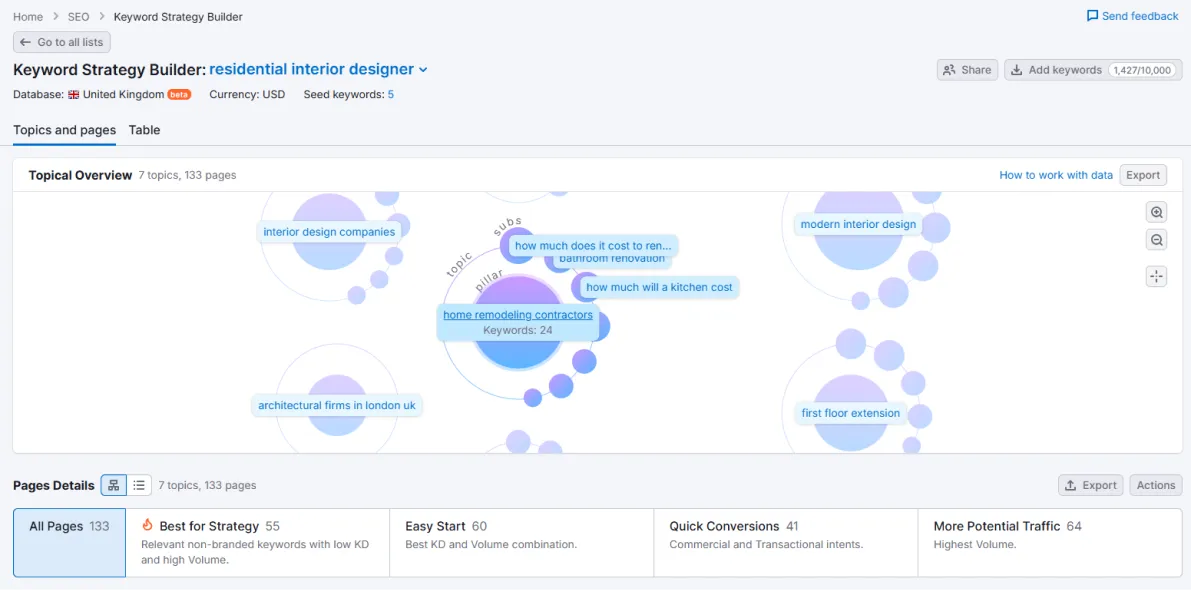
The practical rule: if the same pages appear in the top results for two different keywords, those keywords can be targeted by a single page. If the top results are completely different sets of pages, those keywords need separate pages.
Creating a separate page for every minor keyword variation is one of the most common mistakes on new websites. It splits your authority across many thin pages instead of concentrating it on fewer, stronger ones.
Step 7: Prioritising Your Keyword List
After keyword research, you will typically have far more opportunities than you have time to create content for. The question of which keywords to target first comes down to four factors weighted together:
Traffic potential - how much traffic could realistically come from this keyword if you ranked in the top three positions?
Keyword difficulty - how realistic is it for your site at its current authority level to rank for this keyword in the next six to twelve months?
Business value - if someone searches for this keyword and lands on your page, how likely are they to become a customer or take a meaningful action?
Content investment required - how much effort does it take to create a page that genuinely deserves to rank for this keyword?
Hear What It's Like to Work With Vaphers!
"Vaphers is a fantastic company to work with. They provide the reporting I need, the results I want, and if there is a problem, they reach out first and have a plan for adjustments. I cannot recommend them enough."
Rachana G. - Interior Designer
A keyword with moderate traffic potential, low difficulty, high business value, and straightforward content requirements should be at the top of your list. A keyword with enormous traffic potential but very high difficulty and unclear commercial value should wait until your site has more authority.
For a new website, the priority ordering almost always runs: low-difficulty informational keywords first, to build topical authority and start generating backlinks naturally. Commercial and transactional keywords targeting local or niche-specific queries second. High-difficulty head terms last, once the site has demonstrated a track record.
Keyword Research is Ongoing, Not a One-Time Task
The final thing most guides do not say clearly enough: keyword research is not something you do once when you launch a website. Search demand changes. New topics emerge. Competitors appear. Seasonal patterns shift volume up and down throughout the year.
Revisiting your keyword strategy every three to six months, checking what your existing pages are now ranking for in Search Console, identifying new opportunities in Semrush, and reviewing which pages are underperforming relative to their potential is what separates sites that plateau from sites that compound their traffic over time.
If you want a done-for-you keyword strategy built around your specific business, industry, and competition level, our affordable SEO services include keyword research and content planning as a core part of every engagement.
Related: SEO Made Simple: A Complete Layman's Guide · What Actually Decides Google Rankings · On-Page SEO: The Only Strategy You Need
About the Author: Muhammad Asad
Digital marketing strategist, SEO consultant, and technology writer contributing insights on search engine optimization, full-stack web development, and digital brand acceleration.